The Hidden Harmony
About this Volume
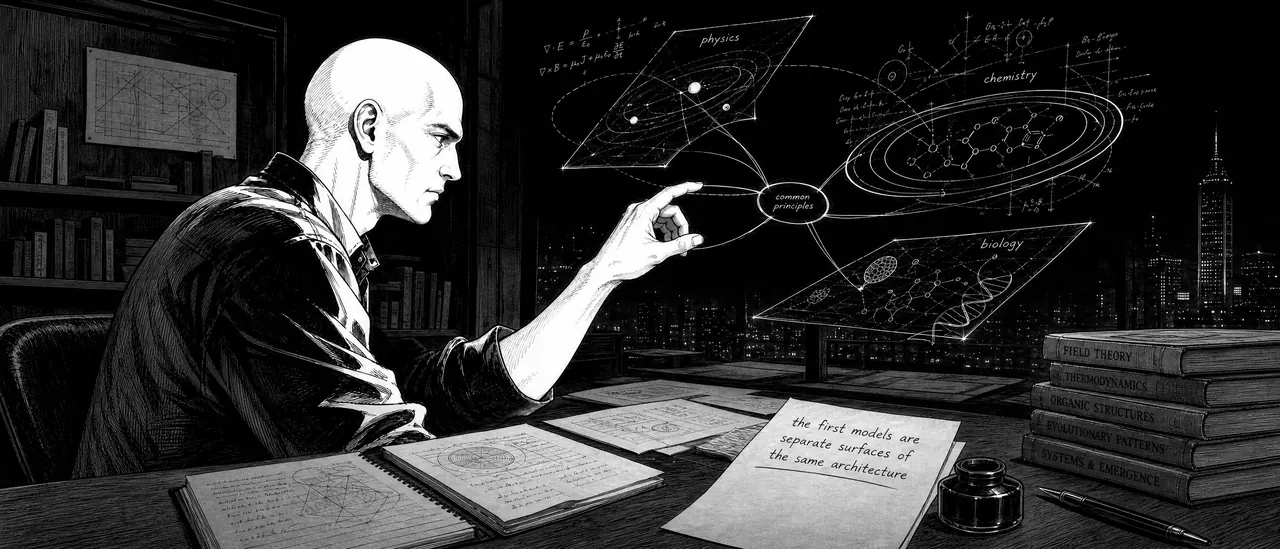
The title is Heraclitus, Fragment 54: the hidden harmony is stronger than the visible. Physics is the science of the harmonies you can't see — the symmetries underneath what appears.
Volume III extends the same architecture into physics — binding energies, dynamics, the things that hold and the things that fall.
On physics
The fundamental claim of physics is that there are fewer laws than there are things. A handful of equations govern the motion of every object that has ever moved. A handful of symmetries determine what can and cannot exist. We do not see this directly. We see particular things moving, particular states settling, particular forces overcoming particular other forces. Underneath, the same harmony — hidden, repeating, indifferent to scale.
Heraclitus said the hidden harmony is stronger than the visible. He had no equations. He had only the observation that change, properly understood, is itself a stable thing.
What we want from a physics model is not a reproduction of the standard textbook. We want the model that has internalised the harmonies — that knows which states are stable because it has learned the rule that makes states stable, not because it memorised which states it has previously seen at rest. That is the difference between a model that can solve physics and a model that can do physics.
What we expect Volume III to do
Predict binding energies and dynamics for systems where the geometry is well-defined but the answer is expensive. Compose physical reasoning across scales — quantum effects at the binding site, classical mechanics at the conformational level, statistical thermodynamics across populations. Bring the cost of useful physics intuition down by an order of magnitude.
What we will not attempt on day one: a theory of everything. The architecture we are extending is general; the empirical claims will be specific.